Selead Prototype Technology Limited
- E-mail :[email protected]
- Tel :+86 0755 2708 5134
3D Printing Materials Selection Guide
Materials must be suited to the application in order to have successful results. The properties of any material become increasingly important as a product
progresses from concept and functional prototyping to production.
However, material properties can only be evaluated when the manufacturing process is considered. It is the combination of the material and the process
that dictates the characteristics. For example, an alloy processed by die casting has different properties when it is metal injection molded. Likewise, a
thermoplastic will have different properties if it is injection molded or CNC machined.
3D printing is unique. It is different from all other manufacturing processes, so the material properties and characteristics of parts that it produces are
different, even when using a nearly identical alloy or thermoplastic. In terms of material properties, it is not a matter of being better or worse; it is simply
important to recognize that the results will be different.

Recognizing that there is a difference, the following information will aid in the characterization, and ultimately the selection, of materials from three widely
used industrial 3D printing processes: selective laser sintering (SLS), and stereolithography (SLA).
SLS Materials
SLS uses thermoplastic powders, predominantly polyamide (PA), to make functional parts that have greater toughness and higher impact strength than
parts produced through SLA, as well as high HDTs (351°F to 370°F). The tradeoffs are that SLS lacks the surface finish smoothness and fine feature
details available with SLA.
Stereolithography ( SLA ) Materials
SLA uses photopolymers, thermoset resins cured with ultraviolet UV light. It offers the broadest material with a large range of tensile strengths, tensile
and flexural moduli, and EBs. Note that the impact strengths and HDTs are generally much lower than those of common injection-molded plastics.The
range of materials also offers options for color and opacity. Combined with good surface finish and high feature resolution, SLA can produce parts that
mimic injection molding in terms of performance and appearance.
Compare Materials
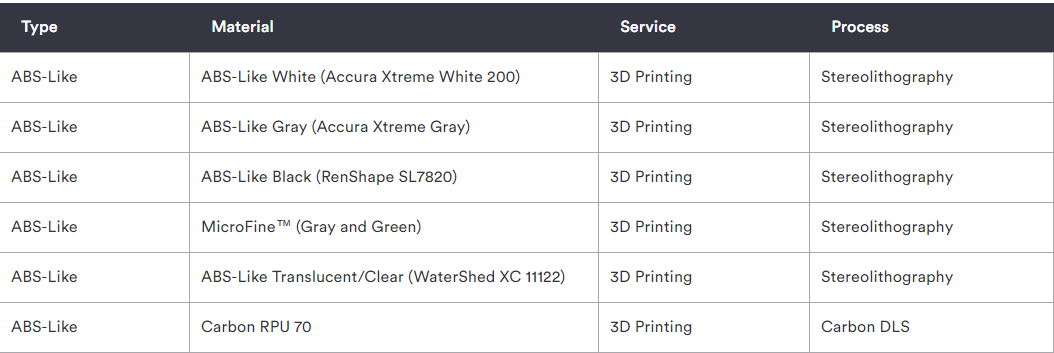
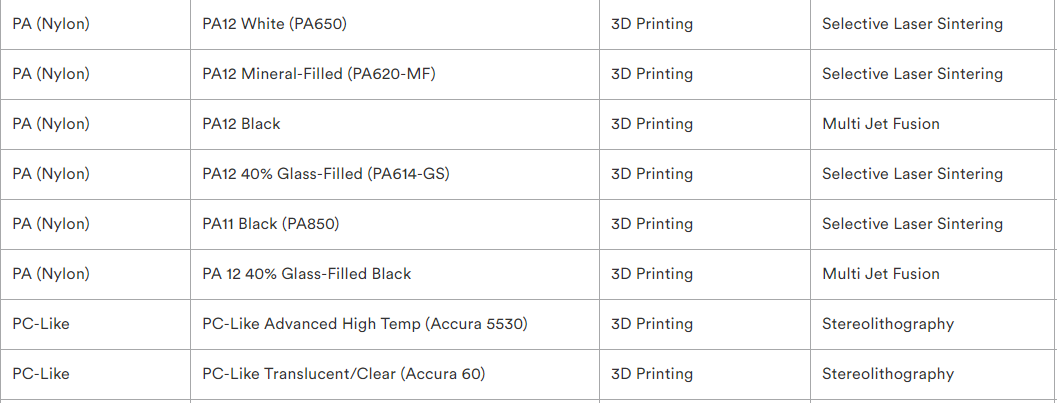
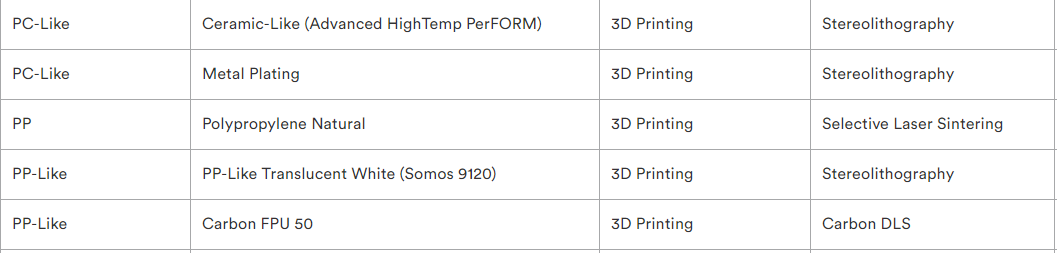
Choosing the Right Additive Manufacturing Material
Spanning metals, thermoplastics, and thermosets, 3D printing provides many different materials that can simulate, if not replace, those that are processed
through conventional means. While an exact match is not possible, since the fundamental processes are different, the material breadth means that there is
a strong likelihood that the important material characteristics are satisfied.
The key to success is being open to, and cognizant of, the differences. With the support of an informed, qualified 3D printing resource that can fill in the
data gaps, this mindset opens the door to leveraging the unique advantages that 3D printing technology can offer.