Selead Prototype Technology Limited
- E-mail :[email protected]
- Tel :+86 0755 2708 5134
Sheet Metal Fabrication Techniques
Sheet metal, by definition, starts out flat but can be shaped in many different ways to meet many different requirements. While this paper focuses on the technologies that shape sheet metal by bending it along a single axis, a variety of techniques exist for shaping the material intomulti axis forms that are not
made up of flat planes or bent along a single axis.These include hot and cold forming techniques of deep drawing,hydroforming, spinning, and stamping.
These are the kind of processes that create the body panels for modern vehicles.complex formed objects meta such as sinks, and aluminum beverage
cans.In many cases these techniques are iterative,shaping the metal by repeating the process several times to chang the shape of the metal in increments.
Cold-forming processes addressed here are:
Cutting
● Shearing was long the primary way to cut sheet steel but has now been replaced by faster, more precise methods.
● A punch press can be used to punch and die sets to cut metal. This is particularly effective for cutting relatively simpler parts than would be cut with a
laser or waterjet. Because it can operate at hundreds of strokes per minute, a punch press can make suitable parts quickly. Punching can also be used to
make holes or other cutouts in parts. Combining punch and laser cutting allows the creation of a complex flat pattern with size-limited stamped features.
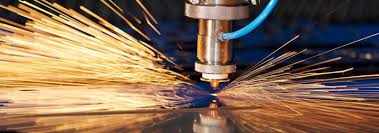
● CNC laser cutting works with jets of oxygen, nitrogen, helium, or carbon dioxide to burn away metal and produce a clean, finished edge. The speed of
this process differs with the thickness of the metal, but the cut can be quite complex and, at tolerances of +/- 0.005 in. or better, is quite precise. And
because there is no contact, the tool does not wear out the way a mechanical cutter does. Two types of lasers are used in sheet metal fabrication. Fiber-
optic laser are used for thinner and more reflective materials to deliver precise cuts. Multi-gas or CO2 lasers are more powerful and suitable for thicker
gauges.
● Photochemical machining is a process of controlled etching using CAD-generated stencils to leave a pattern that is chemically activated to remove
unwanted metal.
Bending
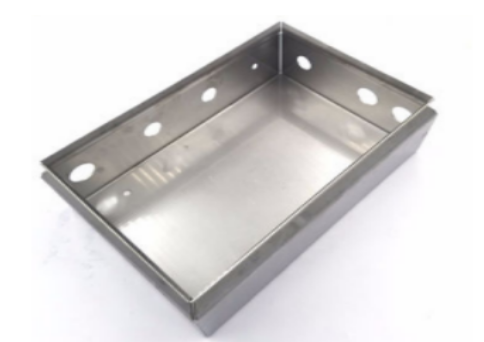
Most metals can be bent along a straight axis using a variety of presses. The shapes of bends can range from gentle curves, such as those along the
vertical axis of a steel can, to sharp corners at angles above, below, or right at 90 degrees. Press brakes are used to create these relatively sharp bends.
rolling and forming methods produce open or closed single-axis curves in a continuous bending operation.
Hemming
This involves rolling the edge of a metal shape to provide a smoother, stronger edge. Hems can be open, leaving an air space within the bend, or closed, in
which the folded metal is pressed tight against itself. Curling produces a rounded edge to a piece of metal, also called a barrel hem. This can be used to
simply eliminate the sharp edge or to serve a specific operational function as in the case of a door hinge where it holds the pin around which the hinge
rotates.